Local Search Signals That Actually Predict Footfall
In this article
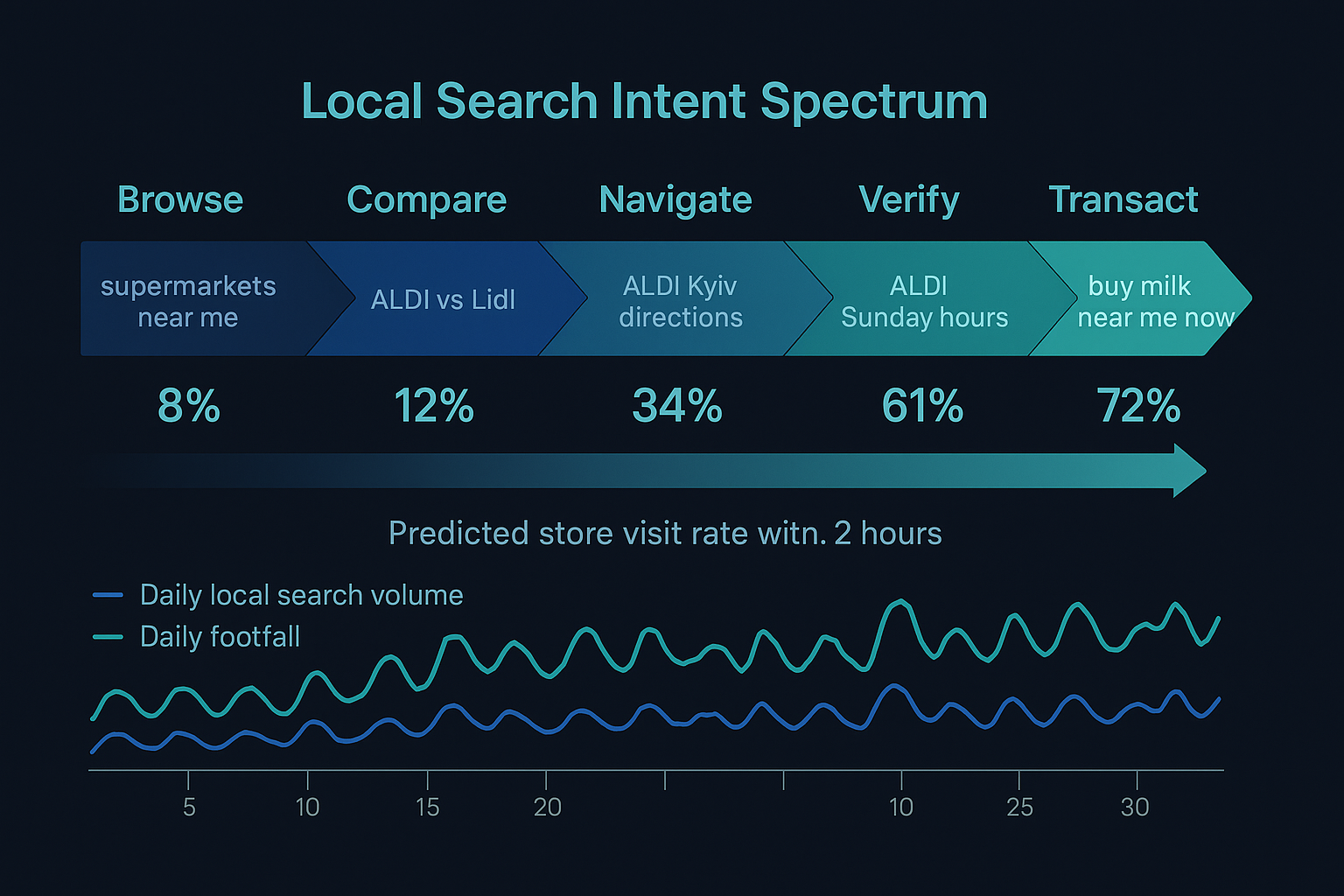
Local search is frequently treated as a single channel — "we're getting local search traffic" — when in practice it encompasses a spectrum of intent states with very different conversion profiles. Someone searching "supermarkets near me" to browse options is not in the same intent state as someone searching "ALDI opening hours Sunday." Both appear in local search data. Only one of them reliably results in a store visit within the next few hours.
This matters practically because it affects where you invest in local search optimisation and how you interpret local search signals as leading indicators of in-store performance.
A working taxonomy of local search intent
Drawing on published research from Google's Consumer Insights team and BrightLocal's annual local search studies, local search queries broadly fall into four intent categories:
Discovery intent: Queries like "coffee shops near me," "clothing stores in [city]." The user is building an awareness set, not committing to a specific destination. Conversion-to-visit rates for this category are lower — typically in the 12–18% within-24-hour range.
Evaluation intent: Queries involving reviews, comparisons, or specific attributes: "best running shoes store London," "Nike store vs Footlocker." The user has narrowed to a category and is choosing a specific location. Conversion rates rise to 25–35%.
Navigation intent: Queries showing a specific destination decision has been made: "[store name] address," "directions to [store]," "[store name] opening hours." These are the highest-converting local search interactions — conversion-to-visit rates of 60–75% within the same day are documented consistently across studies.
Transactional local intent: Queries combining a product with a location signal: "Nike Air Max 90 in stock near me," "same day flower delivery [city]." Strong intent, but the conversion depends on whether the product is actually available — creating potential for a conversion gap that doesn't show up in search data.
Conversion rates by category and intent type
The relationship between intent type and footfall conversion is consistent directionally but varies in magnitude by retail category. Food service converts navigation intent at much higher rates than, say, furniture — the purchase cycle and visit decision timeline are fundamentally different.
| Category | Navigation intent → visit (24h) | Evaluation intent → visit (24h) | Discovery intent → visit (24h) |
|---|---|---|---|
| Food & Beverage | 74% | 41% | 22% |
| Grocery | 68% | 38% | 19% |
| Fashion & Apparel | 52% | 29% | 14% |
| Health & Beauty | 61% | 33% | 17% |
| Home & Furniture | 34% | 18% | 8% |
| Consumer Electronics | 41% | 22% | 11% |
Sources: Google Consumer Insights 2025, BrightLocal Local Consumer Review Survey 2025, Uberall Location Marketing Benchmark 2025. Figures are median conversion rates from published study data; methodology notes below.
Which signals to monitor in practice
If you have access to Google Business Profile Insights data (now surfaced through the Performance section of GBP), several specific signal types are worth tracking as leading indicators of footfall:
Direction requests. This is the highest-intent signal available in GBP Insights and the most reliable predictor of same-day in-store visits. Track this weekly and by location. A sustained decline in direction requests with stable or growing search impressions suggests a conversion gap somewhere between search and visit decision.
"Get website" vs "call" vs "directions" split. These three GBP interaction types have materially different downstream conversion rates. For most retail categories, the directions-to-calls ratio is a useful signal of visit intent. A high ratio of website clicks relative to directions suggests your local search traffic is in an earlier research phase.
Query type breakdown in Search Console. If your location pages are ranking in local search, Google Search Console shows the query breakdown. The ratio of navigational queries (brand + location) to discovery queries (category + location) tells you something about how much of your local search traffic is from people who already know you versus people discovering you.
Map views versus website visits from GBP. A high ratio of map views to website visits indicates that people are finding your location but not engaging further with your content — often a sign of strong navigation intent, which is positive for footfall. A low ratio suggests your GBP is surfacing in more research-phase searches.
Monitoring framework
Weekly: Direction requests by location — track trend, flag declines
Monthly: Direction / website / call split — track ratio shifts
Quarterly: Query type ratio from Search Console — navigational vs discovery
Quarterly: Map views vs website visits ratio from GBP — intent phase indicator
Where the conversion gap usually sits
For most retailers who are seeing flat in-store performance despite reasonable local search volume, the conversion gap is usually in one of three places:
Discovery to evaluation. The business appears in local search for category queries but doesn't have sufficient review volume, star rating, or attribute completeness to make the evaluation set. Competitor locations with more reviews are selected instead.
Evaluation to navigation. The business is being considered but the specific triggers for a visit decision — opening hours, stock availability, specific attributes — are either absent from the listing or negative. Hours accuracy is the most common problem here; an incorrect closing time in GBP will suppress direction requests from users who check before visiting.
Navigation to physical arrival. A less common but real failure mode: the user requests directions but doesn't complete the visit. This can happen due to parking, accessibility, or simply because the route revealed a competitor on the way. This one is harder to address through digital means.
The practical value of intent-segmented local search monitoring is that it lets you identify which stage the conversion gap is occurring at — without needing a complex measurement infrastructure. GBP Insights, Search Console, and a consistent tracking discipline get you most of the way there.