Which Attribution Model Actually Works for Retail?
In this article
Attribution modelling in retail is one of those topics where the default choice — last-click — is also reliably the wrong one for most omnichannel marketers. If you're running local campaigns, upper-funnel awareness, or any channel that contributes early in the purchase journey, last-click is systematically removing credit from precisely the channels you need to understand.
This piece walks through the practical choice between attribution models, what each one actually measures, and how to select one based on your specific purchase cycle and channel infrastructure — not based on which one is easiest to implement.
Why last-click fails local retail specifically
Last-click attribution assigns 100% of conversion credit to the final touchpoint before a customer takes action. In a purely digital, short-cycle environment — say, a search ad that leads directly to an e-commerce checkout — this has a reasonable logic.
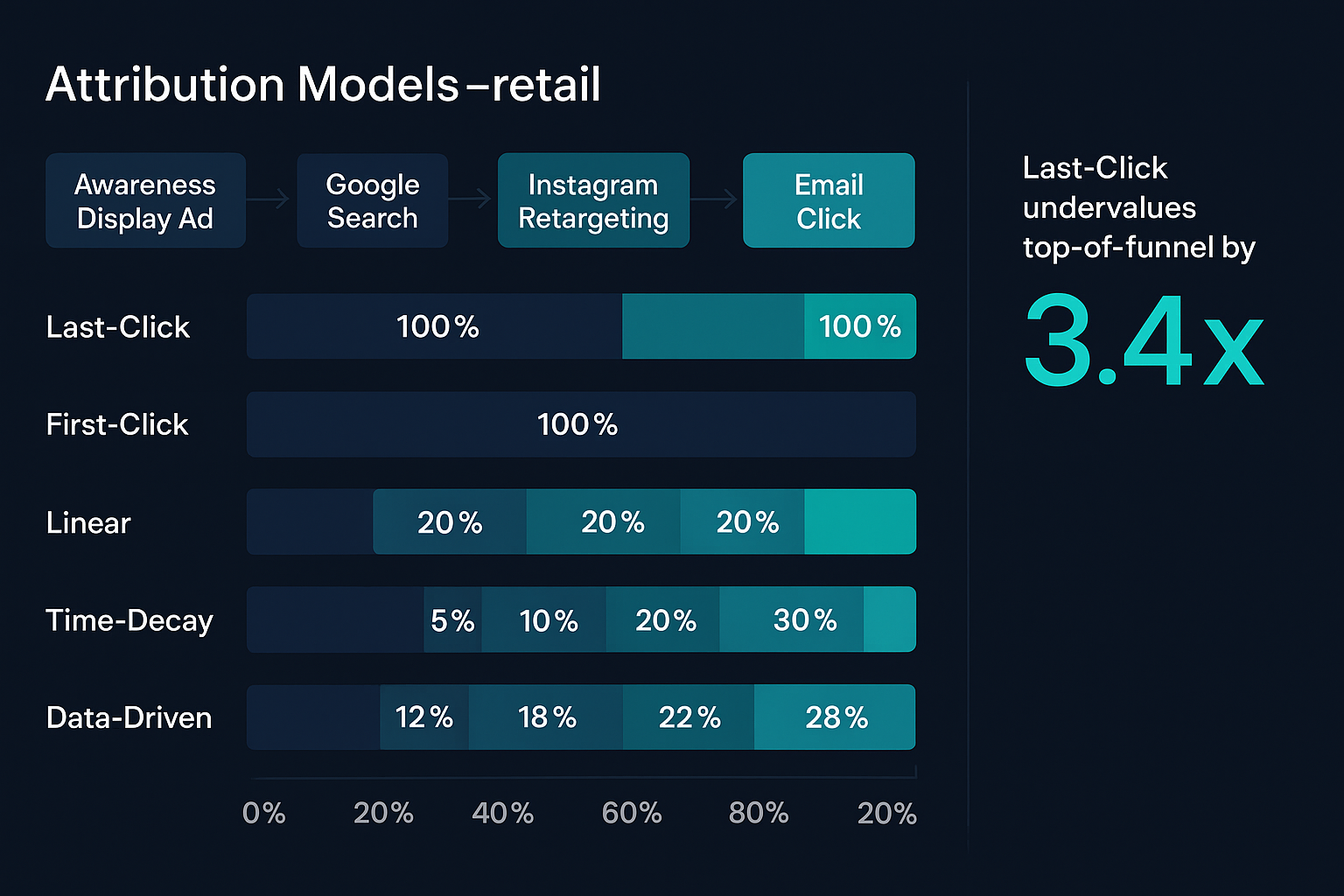
In retail, the problem is that the final tracked touchpoint is rarely the one that drove the decision. A customer might encounter a display ad on Monday, search for directions via Google Maps on Wednesday, and walk in on Thursday. Under last-click, the Maps direction request gets all the credit. The display campaign gets nothing. Your budget decisions get distorted accordingly.
In a study of 84 mid-market retail advertisers, switching from last-click to a data-driven model changed budget allocation by an average of 31% across channels — with display and local awareness campaigns gaining the most credit.
The mismeasurement compounds across categories. For fashion retail, where the research-to-visit cycle is often 4–8 days and spans multiple channels, last-click can understate the contribution of paid social by 40–60% compared to a time-decay or data-driven model.
The five models — what each actually does
There are five main attribution models in common use. Here's what each does, and what it gets wrong.
Last-click
100% credit to the final touchpoint. Fast to implement, easy to explain to stakeholders. Systematically undervalues awareness and consideration-stage channels. Appropriate only if your purchase cycle is same-session and your customers reliably convert on the first touchpoint.
First-click
100% credit to the first recorded touchpoint. Useful for measuring what drove initial discovery — which matters if you're trying to scale awareness. Has the opposite problem to last-click: it ignores everything that converted the interest into a visit. Rarely used as a primary model, more useful as a comparison lens.
Linear
Distributes credit equally across all touchpoints in the conversion path. More honest than single-touch models in that it acknowledges the full path. The downside is that it weights low-value touchpoints (a banner ad someone scrolled past) equally with high-intent touchpoints (a store locator click). It's a starting point, not an end state.
Time-decay
Assigns increasing credit to touchpoints closer to conversion, with a configurable half-life. More credit to recent touchpoints, less to earlier ones. Works reasonably well for shorter purchase cycles (under 7 days) where recency is a reliable proxy for influence. For longer cycles or considered purchases, it may still undervalue the initial discovery touchpoints.
Data-driven (DDA)
Uses machine learning to assign credit based on the actual conversion probability contribution of each touchpoint, derived from your account's historical path data. This is the most accurate model available within platform attribution systems — but it requires a minimum volume (Google requires approximately 400 conversions and 4,000 ad interactions per month) to produce reliable output. Below that threshold, the model is not stable enough to be useful.
Model selection matrix
Use this as a starting-point guide, not a rule:
- Purchase cycle <2 days, single channel: Last-click acceptable
- Purchase cycle 2–7 days, 2–3 channels: Time-decay
- Purchase cycle 7+ days, multi-channel: Position-based (40/40/20)
- 400+ conversions/month, multi-channel: Data-driven
- Measuring channel discovery only: First-click (as a secondary view)
The offline conversion layer
The above all assumes you're measuring digital-to-digital conversions — click to online purchase, for example. For O2O retail, there's an additional layer: you need to connect the digital attribution data to offline conversion events (store visits, in-store purchases).
This requires one of three approaches, in increasing order of reliability:
- Platform-modelled store visits (Google Store Visits, Meta Store Traffic objective): Modelled from aggregated location data. Reasonably accurate for high-volume campaigns (see the accuracy analysis linked below), but not transaction-level data.
- CRM/POS matching: Match your customer email or loyalty ID database against ad platform data. Requires customer identification at point of sale and data sharing with the ad platform. More accurate than modelled data; slower to set up.
- Third-party footfall platforms: Dedicated location intelligence vendors that use GPS panel data to attribute store visits to ad exposures. More granular than platform data; adds cost and integration overhead.
The attribution model you choose for digital channels matters less than ensuring you have any offline conversion signal at all. Many retailers running sophisticated multi-touch models are still optimising entirely on digital conversions — which means their models are accurate about the wrong thing.
What to actually do
A few practical decisions that often get skipped in attribution discussions:
Set the conversion window correctly. Most platforms default to 30-day click, 1-day view. For retail with a 2–4 day purchase cycle, this creates noise from conversions that were not causally related to the ad. A 7-day click window is a more defensible starting point for most categories.
Audit what counts as a conversion. If your conversion actions include things like homepage visits or newsletter signups alongside store visit events, your attribution data is mixing very different signals. Separate these into distinct conversion categories before drawing conclusions about channel performance.
Run the comparison before committing. Google Ads lets you view conversion data under both your current model and any alternative model side-by-side. Run this comparison for 90 days before switching — the delta shows you exactly which channels your current model is mismeasuring.
Attribution modelling is infrastructure work. It produces slow returns compared to changing a headline or adjusting a bid strategy. The reason it matters is that every budget decision you make downstream is running on the output of this model. A well-calibrated attribution setup doesn't improve results directly — it reduces the likelihood that you're systematically misallocating budget based on accurate-looking but structurally wrong data.
Mentioned in context of this article
A multi-touch attribution and marketing analytics platform designed for brands with complex channel mixes. Northbeam builds its attribution model from first-party pixel data and does not rely solely on platform-reported conversions — which addresses one of the core problems discussed in this article. It supports custom attribution windows, offline conversion import, and channel comparison views. Relevant for retailers spending across three or more paid channels who have outgrown platform-native attribution reporting.
View NorthbeamSponsored. O2O Blog may earn a commission if you sign up through this link. Our editorial opinions are not influenced by sponsorships.